


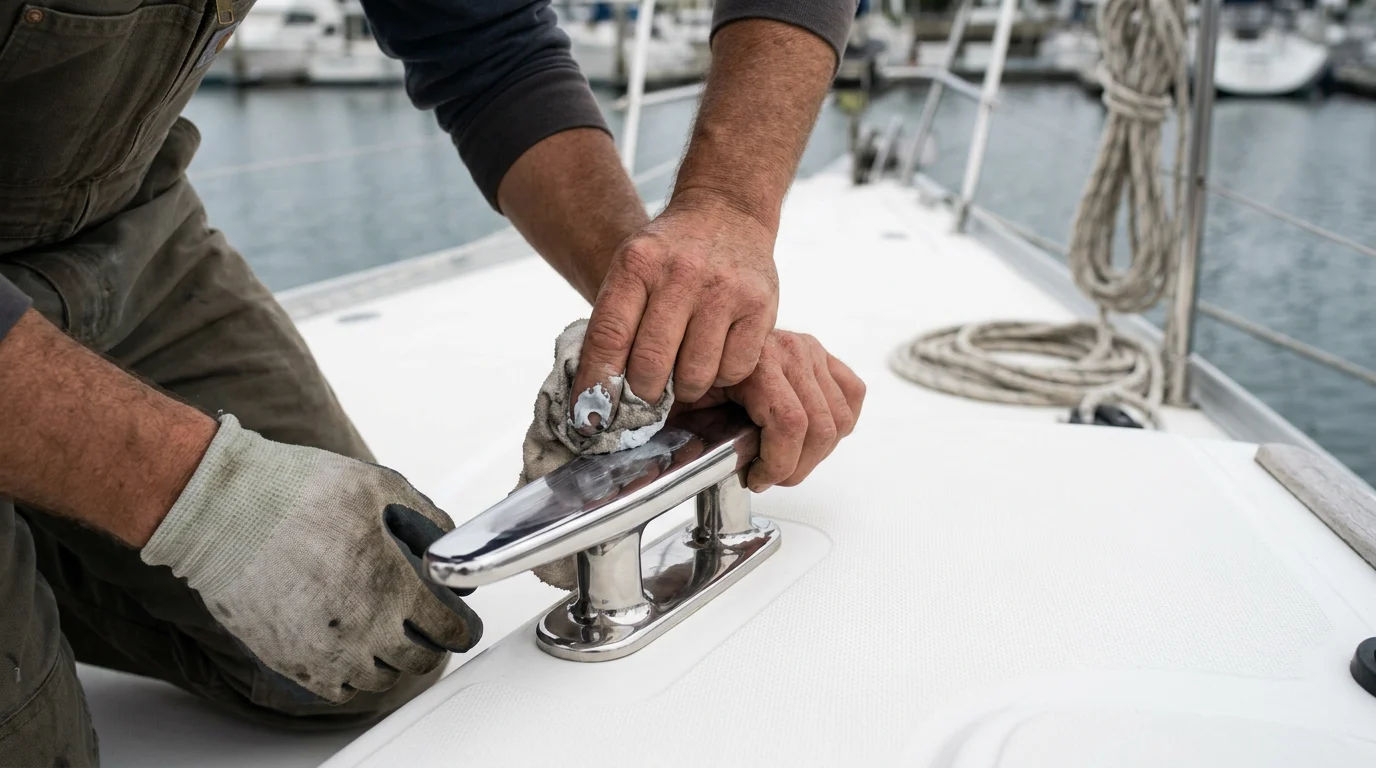
Saltwater is unforgiving: chloride exposure, UV radiation, and temperature swings can turn poorly finished hardware into a maintenance liability. In marine applications, polishing is a performance requirement, not just a cosmetic upgrade. The right finish can reduce pitting corrosion, limit biofouling, protect ropes from chafe, and extend the service life of stainless steel, brass, bronze, and aluminum components. This article explains how surface roughness, alloy selection, abrasive methods, and finish specifications affect durability in offshore, yacht, and commercial vessel environments. It also highlights practical benchmarks—such as sub-0.2 µm Ra mirror finishes and 316L stainless performance—to help engineers, fabricators, and maintenance teams make smarter finishing decisions.
Why Marine Hardware Polishing Matters
Marine environments present one of the most hostile atmospheric and chemical challenges for mechanical hardware. The relentless exposure to saltwater, ultraviolet radiation, and fluctuating temperatures demands superior surface engineering. Marine hardware polishing is not merely an aesthetic enhancement; it is a fundamental metallurgical necessity that determines the functional longevity of critical maritime components.
Corrosion resistance in harsh marine environments
Corrosion resistance is the primary driver for high-grade surface finishing. In marine applications, airborne chlorides and direct saltwater contact accelerate galvanic and pitting corrosion on rough surfaces. By mechanically smoothing a metal component, polishing removes microscopic peaks and valleys where moisture, salt, and oxygen typically accumulate to form localized corrosion cells. For instance, achieving a pristine surface on Type 316L stainless steel enables the material to resist degradation. This grade boasts a Pitting Resistance Equivalent Number (PREN) greater than 23, and industry estimates suggest it can withstand standard ASTM B117 salt spray testing for well over 1,000 hours without exhibiting red rust.
Key terms and finish expectations
Navigating the technical specifications of surface finishing requires an understanding of key metrological terms. Roughness Average (Ra), measured in micrometers (µm) or microinches (µin), quantifies the microscopic deviations of a surface from its ideal form. In maritime engineering, a standard mill finish might exhibit an Ra of 3.0 to 6.0 µm, whereas a true marine-grade mirror polish requires an Ra of less than 0.2 µm. Additionally, industry professionals differentiate between buffing, which uses loose abrasives on a soft wheel to generate high luster, and polishing, which utilizes fixed abrasives to remove material and level the surface.
Aesthetic, safety, and lifecycle benefits
Beyond fundamental corrosion prevention, highly polished hardware delivers significant lifecycle and operational benefits. Smooth surfaces drastically reduce biofouling, as marine organisms struggle to adhere to substrates lacking micro-crevices. From a safety perspective, highly polished cleats, rails, and fairleads minimize friction and chafe on synthetic mooring lines. This reduction in wear can extend the operational life of expensive rigging by an estimated 40%. Aesthetically, the flawless reflectivity associated with luxury yachts and commercial vessels signals rigorous maintenance and uncompromising quality standards.
Materials and Finish Specifications

The effectiveness of any polishing operation is inherently tied to the base material and the precise finish specifications required by the engineering design. Specifying the correct combination of alloy and surface texture dictates both the manufacturing methodology and the ultimate performance of the hardware in a maritime setting.
Stainless steel, brass, bronze, and aluminum
Stainless steel, specifically austenitic grades like 316 and 316L, dominates the marine hardware sector due to its inherent molybdenum content, which resists chloride degradation. However, non-ferrous metals also play critical roles. Naval brass and silicon bronze are frequently polished for classic vessel restorations and specialized underwater fittings. These metals require distinct abrasive compounds to avoid surface smearing. Marine-grade aluminum alloys, such as 5083 and 6061, offer high strength-to-weight ratios but are highly susceptible to oxidation. Polishing these alloys often serves as a prerequisite for subsequent anodizing or protective clear-coating processes.
Mirror, satin, and brushed finish options
The selection between mirror, satin, and brushed finishes depends on the component's location and function. Mirror finishes provide maximum corrosion resistance and aesthetic appeal but show fingerprints and scratches easily. Satin finishes offer a muted, non-directional sheen that hides minor wear, while brushed finishes present a distinct, directional grain.
| Finish Type | Typical Ra (µm) | Primary Marine Application | Relative Cost Index |
|---|---|---|---|
| Mirror Polish | < 0.2 | Deck hardware, handrails, cleats | High (1.5x - 2.0x) |
| Satin Finish | 0.4 - 0.8 | Interior fittings, structural brackets | Medium (1.2x) |
| Brushed Finish | 0.8 - 1.2 | Heavy-use steps, galley components | Baseline (1.0x) |
Critical finish metrics to specify
Relying on subjective terms like "shiny" or "smooth" introduces severe quality control risks during procurement. Engineers must mandate quantifiable finish metrics on technical drawings. A rigorous specification should define the acceptable Ra tolerance (e.g., Ra 0.15 ± 0.05 µm) and, for highly reflective components, a minimum gloss unit (GU) or reflectivity percentage exceeding 85%. Furthermore, referencing established international standards, such as ISO 1302 for surface texture indication and ISO 4287 for Ra measurement, ensures global supply chain alignment regarding surface texture measurement and acceptable defect limits.
Professional Polishing Process
Transforming a rough casting or machined billet into a marine-grade polished component is a labor-intensive, multi-stage process. It requires a systematic progression through increasingly finer abrasives, governed by strict operational parameters to ensure metallurgical integrity.
Grinding, sanding, and surface preparation
Surface preparation begins with aggressive material removal to eliminate casting scale, machining marks, and deep surface imperfections. Operators typically commence with coarse grinding belts or wheels ranging from 60 to 80 grit. The process demands meticulous step-down procedures, transitioning through 120, 240, 320, and eventually 400 or 600 grit abrasives. Skipping a grit stage inevitably leaves deep micro-scratches that remain invisible until the final buffing stage, necessitating costly rework. Maintaining consistent pressure and direction is critical to avoid localized work hardening of the stainless steel.
Compounds, abrasives, and wheel selection
Once the surface is uniformly leveled, the process shifts to compounds and wheel selection to develop the final luster. Sisal wheels paired with coarse emery compounds cut the initial polish, followed by treated cotton or muslin wheels loaded with finer aluminum oxide or chromium oxide (rouge) compounds. The thermodynamic interaction between the wheel, compound, and metal is critical. Spindle speeds generally operate within an estimated range of 1,500 to 3,000 RPM to generate the exact friction required to melt the compound binder without warping or overheating the hardware.
Common polishing defects and prevention
Despite stringent process controls, polishing defects can compromise both aesthetics and corrosion resistance. "Orange peel" occurs when excessive pressure or heat distorts the surface grain, while microscopic pitting often results from impurities in the base casting being exposed during material removal. Burning or blueing of the metal indicates excessive thermal input, which depletes the chromium layer and destroys the stainless steel's passivity. Aggressive mechanical polishing can itself impair corrosion resistance if this heat input is uncontrolled. Consequently, proper post-polish passivation of stainless steel is a critical step professional buyers expect to see explicitly addressed to restore the protective oxide layer. Implementing automated robotic polishing cells for high-volume, uniform geometries has helped modern manufacturers drive defect rates below an estimated 2% threshold, ensuring consistent marine-grade quality.
Quality, Compliance, and Supply Chain Risk
Procuring polished marine hardware involves navigating a complex matrix of quality assurance, regulatory compliance, and logistical variables. The highly manual nature of surface finishing introduces inherent supply chain vulnerabilities that buyers must actively mitigate.
Inspection methods and documentation
Validating a marine polish requires robust inspection methodologies beyond standard visual checks. Quality assurance teams utilize contact profilometers to verify Ra values and gloss meters to quantify reflectivity. Visual inspections must be conducted under controlled lighting environments to identify microscopic swirl marks or compound residues. Inspectors typically utilize lamps rated at an industry-standard 1,000 lux for this purpose. Comprehensive documentation, including surface roughness reports and material test reports (MTRs), should accompany every shipment to trace the component's metallurgical and finishing pedigree.
Environmental and worker safety requirements
The polishing industry faces intense scrutiny regarding environmental impact and occupational health. Airborne metal dust and volatile organic compounds (VOCs) emitted by polishing compounds pose severe respiratory hazards. Consequently, reputable facilities must operate under strict environmental management systems. Compliance with ISO 14001 for environmental management often dictates the installation of advanced wet-dust extraction systems utilizing HEPA filtration rated for an estimated 99.9% efficiency. Buyers must audit suppliers to ensure adherence to these safety protocols, as environmental shutdowns can instantly sever the supply chain.
Volume, geometry, packaging, and lead time risks
Complex hardware geometries exponentially increase processing time and supply chain risk. A component with deep recesses or internal angles can require up to an estimated 300% more manual polishing time compared to a flat surface, directly impacting Minimum Order Quantities (MOQs) and factory throughput. Furthermore, highly polished items are incredibly susceptible to transit damage. Inadequate packaging can result in scrap rates estimated at 5% to 10% simply from components abrading against one another during shipping. Consequently, buyers must factor in the cost of individual polybagging, foam isolation, and extended lead times. This extra care often adds an estimated 2 to 3 weeks specifically for the finishing phase.
Choosing the Right Polishing Strategy
Determining the optimal surface finish for marine hardware requires a strategic balance between engineering requirements, aesthetic expectations, and budget constraints. Over-specifying a finish unnecessarily inflates costs, while under-specifying invites premature component failure.
When to use mirror polishing
Mirror polishing is the definitive choice for above-waterline components exposed to direct salt spray, UV radiation, and high passenger visibility. Deck cleats, handrails, bimini top fittings, and anchor rollers benefit immensely from this ultra-smooth surface, which prevents salt crystallization and provides a premium aesthetic. Additionally, critical sanitary or potable water fittings on commercial vessels mandate mirror finishes to eliminate bacterial harboring sites, ensuring compliance with strict maritime hygiene regulations.
Balancing cost, durability, and appearance
Achieving a flawless mirror finish is a labor-intensive endeavor that typically adds an estimated 20% to 40% cost premium over standard mill or brushed finishes. Procurement teams must evaluate the lifecycle cost-benefit ratio. For structural components hidden within the hull, engine room brackets, or underwater fittings heavily coated in antifouling paint, a standard brushed or vibratory finish offers sufficient mechanical integrity without the associated cost penalty. Strategic allocation of polishing budgets ensures that capital is directed toward components where surface smoothness dictates survival.
Final decision checklist
To streamline procurement and engineering alignment, buyers should utilize a structured evaluation matrix before finalizing hardware specifications. Assessing the operating environment, required lifespan, and budget allows for data-driven finishing decisions. Furthermore, integrating supplier qualification questions into this process is essential. Requesting sample Ra reports and inquiring about polishing compound VOC compliance bridges the gap between technical specifications and supply chain risk management.
| Decision Parameter | Mirror Finish (Ra < 0.2 µm) | Brushed/Satin Finish (Ra 0.4 - 1.2 µm) | Mill/Raw Finish (Ra > 3.0 µm) |
|---|---|---|---|
| Environmental Exposure | Direct salt spray, heavy UV | Protected exterior, interior cabins | Enclosed engine rooms, painted areas |
| Biofouling/Salt Accumulation Risk | Extremely Low | Moderate | High |
| Maintenance Requirement | Low effort, high frequency (wiping) | Medium effort | High effort (corrosion removal) |
| Cost Implication | +20% to 40% premium | +5% to 15% premium | Baseline cost |
Key Takeaways
- Specify marine hardware finishes by measurable Ra values, targeting less than 0.2 µm Ra when a true mirror-grade corrosion-resistant surface is required.
- Use 316 or 316L stainless steel for demanding marine applications because molybdenum improves resistance to chloride-driven pitting.
- Polishing improves corrosion performance by removing microscopic valleys where saltwater, oxygen, and contaminants can form localized corrosion cells.
- Choose material-specific abrasives for stainless steel, brass, bronze, and aluminum to prevent smearing, oxidation issues, or inconsistent surface quality.
- Polished cleats, rails, and fairleads can reduce friction-related line chafe and may extend synthetic rigging life by up to 40%.
- Treat polishing as a functional surface-engineering step, not just a cosmetic process, when hardware must withstand salt spray, UV exposure, and temperature cycling.
Frequently Asked Questions
Why is polishing important for marine hardware?
Polishing reduces microscopic surface peaks and crevices where salt, moisture, and oxygen collect. This helps limit pitting, galvanic corrosion, biofouling, and line chafe, improving both appearance and service life in harsh marine environments.
What surface roughness is typical for a marine-grade mirror finish?
A standard mill finish may measure about 3.0 to 6.0 µm Ra, while a true marine-grade mirror polish typically targets less than 0.2 µm Ra for better corrosion resistance and easier cleaning.
Which stainless steel grade is best for marine polishing?
Type 316 and 316L stainless steel are widely preferred because their molybdenum content improves chloride resistance. 316L is especially useful where corrosion resistance and high-quality polishing are critical.
How does polishing help reduce corrosion in saltwater conditions?
A smoother surface gives chlorides, moisture, and contaminants fewer places to settle. By removing micro-defects, polishing reduces localized corrosion cells that can lead to pitting and premature hardware failure.
Is polishing the same as buffing?
No. Polishing generally uses fixed abrasives to level the surface and remove material, while buffing uses loose abrasives on softer wheels to create high luster after the surface has already been refined.